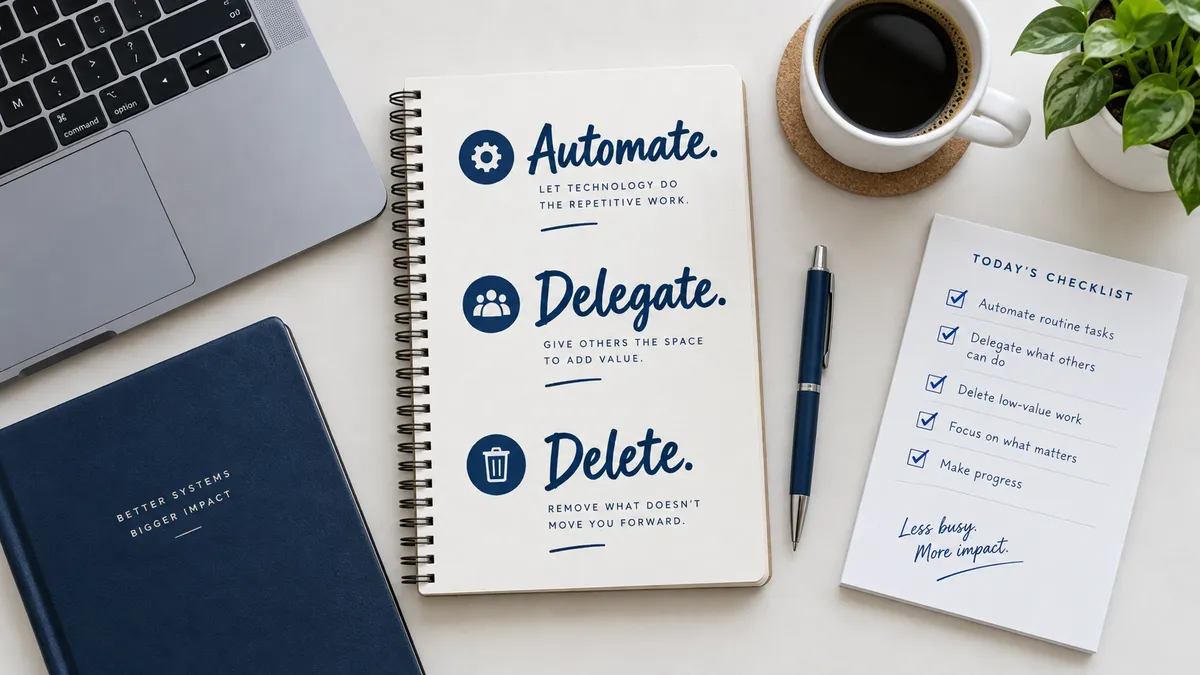
Automate, Delegate, Delete: The A.D.D. Method Every Business Owner Needs
If you've ever ended a packed workday wondering what you actually achieved, you're not alone. Most small business owners are working harder than ever — but not always on the things that move the needle. The good news? There's a simple, three-part framework that can change everything: Automate, Delegate, Delete — or as it's known, the A.D.D. method.
It's not about working less. It's about working on what counts.
What Is the A.D.D. Method?
The A.D.D. method is a practical productivity framework built specifically for business owners. Instead of treating every task on your to-do list as equally important, it asks you to sort your workload into three categories: what can be automated, what can be handed to someone else, and what shouldn't exist at all.
Done consistently, this approach removes the friction that slows businesses down — and creates space for the strategic thinking that actually drives growth.
Step 1: Automate
Automation is the starting point. Technology now exists to handle a wide range of repetitive, time-consuming tasks — from scheduling and invoicing to follow-up emails and social media posting.
The key is identifying the tasks you do regularly that follow a predictable pattern. If you do the same thing the same way more than twice a week, there's a good chance it can be automated. Project management tools, customer relationship systems, and workflow apps can all take on these routine jobs — freeing you up to focus on higher-value work.
Automation doesn't just save time. It also reduces the chance of human error and creates consistency across your operations — two things customers notice and appreciate.
Step 2: Delegate
This is the step most business owners resist — and the one that holds them back the most.
Delegation isn't about giving up control. It's about trusting the right people with the right responsibilities. Effective delegation means matching tasks to the skills and strengths within your team, giving clear instructions, and then stepping back enough to let people do their job.
When you delegate well, you do two things at once: you free up your own time for strategic decisions, and you empower your team members to grow. That's a win on both sides. Businesses that build a culture of delegation — where teamwork is the norm rather than the exception — tend to be more resilient, more productive, and far less dependent on any one person.
The trick is letting go of the idea that every task must go through you. It doesn't. And your business will be stronger for it.
Step 3: Delete
Delete is arguably the most underused step — and the most powerful.
Not every task on your list is worth doing. Some processes exist out of habit. Some meetings never needed to happen. Some reports are being generated for no one in particular.
The delete step asks you to regularly audit your workload and ask a simple question: Does this actually contribute to my business goals? If the honest answer is no, remove it. Eliminating unnecessary tasks isn't laziness — it's precision. It creates focus, reduces decision fatigue, and keeps your team working on what genuinely matters.
Putting It All Together
The A.D.D. method works because it's honest about the fact that not all tasks deserve your attention equally. By automating what's repetitive, delegating what others can handle, and deleting what adds no value, you create a business that runs more cleanly — and gives you the headspace to lead it properly.
Start small. Pick three tasks this week. Ask yourself: can this be automated, delegated, or deleted? The answers might surprise you.
Want to work smarter in your business? Chat with Jay to explore how the right systems can help you reclaim your time and grow with less friction.
Frequently Asked Questions
What does A.D.D. stand for in business?
A.D.D. stands for Automate, Delegate, Delete — a three-step productivity framework designed to help business owners streamline their operations and focus on high-value work.
How do I know which tasks to automate?
Look for tasks you perform repeatedly in the same way — invoicing, appointment reminders, follow-up messages, reporting. If the process is consistent and predictable, there's usually a tool that can handle it.
Is delegation risky for small business owners?
It can feel that way at first, but the risk of not delegating is usually higher. Effective delegation with clear communication and regular check-ins is one of the most reliable ways to scale without burning out.
What's the best way to start deleting tasks?
Audit your weekly schedule and ask for each activity: does this directly contribute to a business goal? If not, it's a candidate for removal. Start with meetings, recurring reports, and tasks that no longer reflect how your business operates today.