The Margin Mirage: Why a 10% Revenue Bump Might Be Killing You
Revenue Flatters. Margin Reveals.
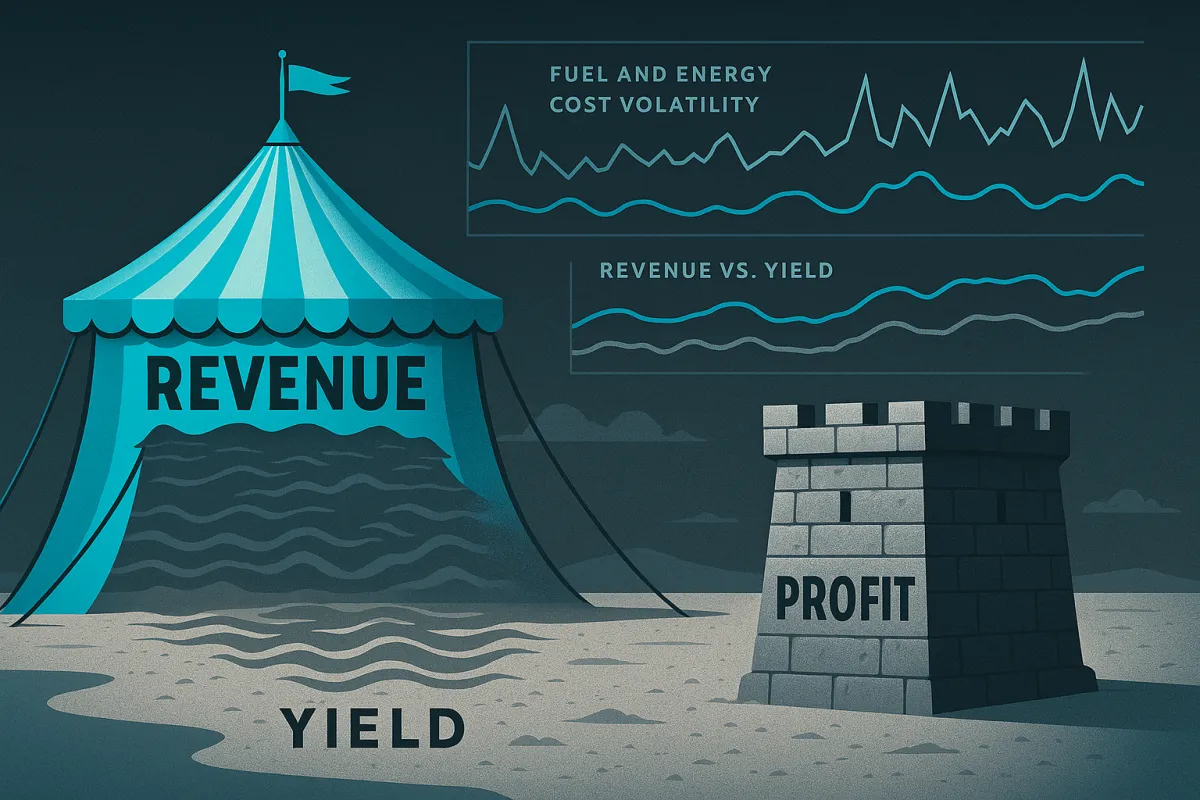
In a period of fuel price volatility, rising energy costs, and ongoing wage pressures, the most dangerous number in your business isn't your revenue — it's the gap between your revenue and your actual yield. And for many Australian small businesses right now, that gap is widening invisibly, hidden behind the flattery of a growing top line. This is the Margin Mirage: the illusion that revenue growth equals business health, when in reality you may be building a bigger tent on a shrinking foundation.
Understanding Yield vs. Revenue
Revenue is what your clients pay you. Yield is what you actually keep after all costs of delivery — not just your direct costs, but all the hidden costs that quietly erode your margin. The Yield Formula:
Yield = Revenue − (Direct Costs + Variable Overhead + Hidden Costs + Owner's Time Cost)
Most businesses track revenue and direct costs. Few systematically track variable overhead and almost none properly cost owner's time — and those omissions make the Margin Mirage possible.
The Hidden Costs That Create the Mirage
- Fuel and transport — Volatile fuel pricing means jobs quoted 90 days ago may be delivered at a significantly higher cost
- Energy costs — Electricity and gas increases directly impact production, refrigeration, and office overhead
- Payment processing fees — Growing revenue means growing fees on credit and debit transactions
- Software subscriptions — Seat-based SaaS pricing scales with your team, eroding margin as you hire
- Financing costs — In a higher rate environment, the cost of working capital credit lines rises
- Owner's time — Time spent on administration, client management, and problem-solving has an opportunity cost that few businesses model
How to Calculate Your Real Yield
- Start with gross revenue — Total invoiced amounts for the period
- Subtract direct costs — Materials, subcontractors, direct labour
- Subtract variable overhead — Fuel, delivery, payment processing, job-specific software
- Subtract fixed overhead allocation — Your share of rent, utilities, insurance, and salaries
- Subtract owner's time at market rate — What would you pay someone to do your job? Cost that.
- What remains is your Yield — This is your real return on the revenue generated
Building a Fortress, Not a Bigger Tent
Growth at any cost is a strategy for the venture-funded — and even many of them don't survive it. For a sustainable small business, the objective is Yield per unit of effort, not raw revenue growth. Ask yourself: if you raised prices by 8% and lost 15% of your clients, would your Yield go up or down? In most cases, it goes up — because you're shedding your most price-sensitive, highest-cost-to-serve clients while retaining your highest-value relationships. Stop chasing the mirage. Calculate your Yield, protect your margin, and build a business that's profitable at its current size before you grow to your next one.